
Effective altruism, or EA, is a movement that I’ve been familiar with since about 2021, but not really involved in. From wikipedia:
a 21st-century philosophical and social movement that advocates impartially calculating benefits and prioritizing causes to provide the greatest good. It is motivated by “using evidence and reason to figure out how to benefit others as much as possible, and taking action on that basis”.
My first significant interaction with EA was when they ran the alternative protein fundamentals programme (APFP) in Cambridge – that’s what got me into alternative proteins and cell ag, so I’m really grateful to them for that. Alternative proteins are a topic of interest for EA because it is considered an effective way to impact upon animal welfare, which is one of their cause areas.
Other than alternative proteins, I have always been sceptical of some aspects of EA – more on that below. However, they do have interesting ideas, and perhaps more importantly, they have tons of money – some of the main benefactors are tech bros from the Bay Area, and some of those bought crypto in the very early days, so especially in 2021-2022 EA was swimming in money. It is a bit less so now, but they still have a lot and do have many funding calls. They and people/organisations aligned with them have funded some of Cell Ag UK’s work, so again I’m very grateful to them for that.
Last weekend (really? I’ve been doing a lot so that seems ages ago now) I attended an EA regional conference in Oslo, EAGx Nordics. I ended up there in a bit of a roundabout way: I spent a couple of months back home in Riga this winter, and there I met Anastasia – a Bulgarian working in UNHCR who I became friends with. Turns out she is involved in EA Latvia: this was a surprise to me, considering my stereotype EA person is a western guy with a tech job and limited social skills, and none of these attributes describe Anastasia. Anyway, once she found out that I’m into alternative proteins, and as I was also still looking for a main job at the time, she really encouraged me to apply to the conference. A big bonus was that EA Nordics are trying to encourage Baltic representation, and while perhaps not surprisingly they have plenty of Estonians, they do not have many Latvians, so Latvians would be more likely to get travel grants, i.e. travel and accommodation for the conference covered. So, I applied, got a grant, and went.

I’m really glad I did actually! One thing that struck me most was how well it was organised and designed. Actually in terms of organisation EA often do live up to their name, but conference design was something that somewhat surprised me: I’ve attended many academic conferences so it was interesting to contrast and compare.
First, here everything is focused on 1-to-1 meetings and networking. There is a programme of talks and workshops but as a participant you are expected to spend most of your time chatting to people. There is an app that allows you to easily schedule meetings, and look up other attendees in a spreadsheet to know who it is that you want to meet. This system works great and I somehow ended up having 7-8 1-to-1s each of the two days. They last 30 min each, so it was absolutely exhausting (I don’t remember being as tired as I was on Monday morning for a long time, even though I slept enough hours that night), but really cool too.
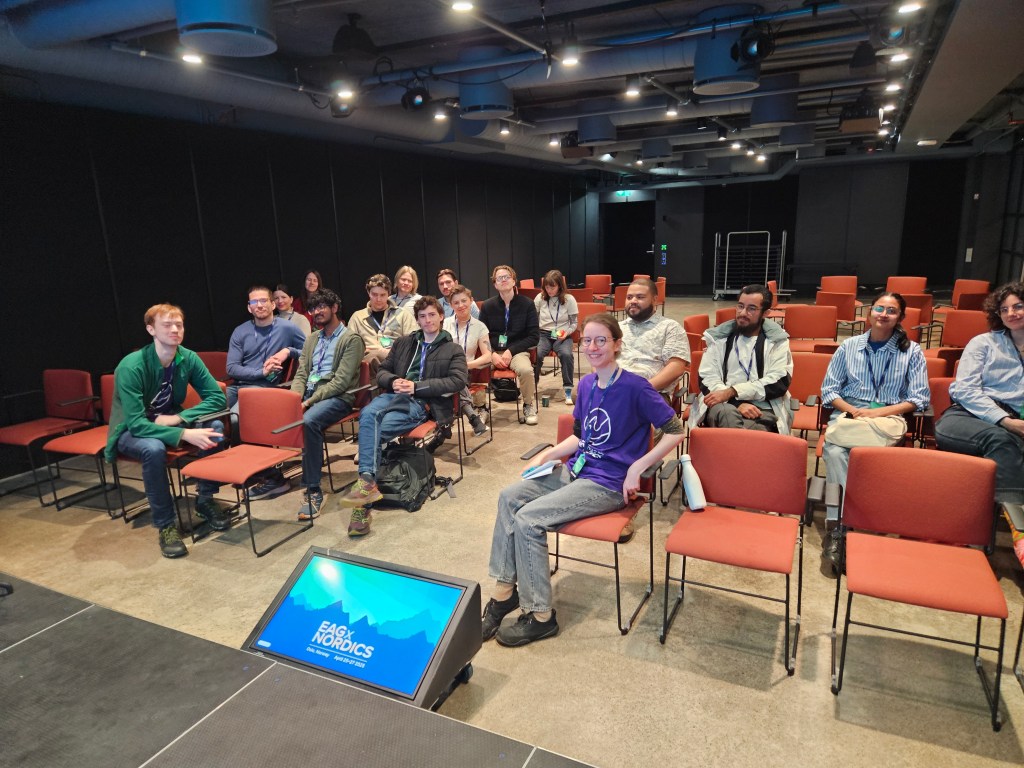
Second, and related to how many 1-to-1s I had, was a personal discovery: there in Oslo I counted as a mid/senior professional, and also was perhaps the most experienced person within alternative proteins/cell ag field, so people wanted to talk to me about it and get my advice on it. This was weird especially at first as I’m used to going to conferences as a PhD student or a postdoc where all attendees are either peers or more senior. It was quite ego-pleasing, of course, and I do think I was able to be helpful to people who wanted my opinions on alt protein stuff. The organisers also asked me to host an alternative protein meetup, giving me flexibility on how to run it, and that was great. Besides, I’ve had plenty of meetings and new connections that were helpful for me too.
Finally, there is a nap room! Literally a room where you can take a nap during the conference. I think this is genius, and actually needed.

I’ve decided to put my more general thoughts and skepticisms of EA into a table, filled with evidence-based observations, in true spirit of effectiveness:
| Concern | Experience so far |
|---|---|
| EA is too obsessed with AI | Online, at funding calls etc, I definitely got this impression: that EA are sacrificing other causes, and core principles, for AI safety and similar (hype or real issues is another question which I don’t feel like I can address). For example, the people that ran APFP that got me into cell ag then founded a company to run such courses – but first they pivoted away from alternative proteins to biosecurity, and now dropped biosecurity too to solely focus on AI safety. Personally, I don’t think this is effective. At the conference, there was plenty of AI stuff but also plenty of other things, and a lot of people shared my opinion above on this. I think region here matters too: apparently at EAG San Francisco there were two groups of attendees, AI and non-AI interested, and these existed virtually in parallel universes/conferences. Senior people in EA that I talked to in Oslo tried to convince me that while funding for AI issues has definitely increased, funding for other areas has not diminished. |
| EA is too arrogant | When I first looked at the conference website, there were only a couple of talks announced, and one of them was titled “What can environmental movement learn from EA” – this says it all about their attitude, I think. Don’t get me wrong, I think there are things that environmentalism can learn from EA, but the way the title is phrased definitely implies superiority. In the final conference programme, the title was adjusted so that they added “.. – and vice versa”, which means someone else noticed it at least, and made a step in the right direction. I have also heard and experienced that people heavily identifying with EA are often too dogmatic, and are unwilling to consider any other approaches, considerations, etc, that do not fall within their framework. There are also some scary EA fringe people (online, at least) that are into human biodiversity theory, which is nothing else than a modern form of racism and eugenics. On a personal level, I realised that a lot of perceived arrogance could be attributed to somewhat limited social skills of some of the attendees and neurodivergence. This may be very non-PC, but frankly effective autism might be a more appropriate name. That said, there were also many lovely and socially-adept (and also lovely socially-inadept!) people at the conference that I’m happy to have met. |
| EA is too utilitarian & dogmatic | In Oslo, as part of EA Latvia group, we had some Ukrainians, who were joking about shrimps: shrimps are somewhat famous in the animal welfare arm of EA, as animals that are farmed but neglected, so reducing their suffering can be a very cost-effective way to do good. In fact, my friend and a former co-director of Cell Ag UK James runs a podcast called “How I learnt to love shrimp”. The core postulate in these lines of thought is that suffering of any living being is equivalent, as you can never experience suffering as a shrimp. It is a great ethics question but Ukrainians kept considering how many shrimps you could save if you stopped financial support for Ukraine… which was both dark and funny. My other favourite example is that in their career advice section, 80 000 hours, EA consider professions like a medical doctor or a homeless support worker highly ineffective and with little impact, as you’d only be helping one person at a time. Below the table I’ve attached a photo from the conference to illustrate this point. At the conference some people who came to talk to me about alternative proteins were considering stuff like: would it be more impactful if I switch my career to that, or to biosecurity. I mean, you do you, but I find these a bit pointless – chance, how well you get on with your boss, and whether you had lunch that day would all have much greater impact on your daily impact (sorry), let alone your career fit and interests. I’ve also recently found out about some more EA-adjacent, or beyond-EA “schools of thought”: for example, reflective altruism blog appears interesting, and integral altruism sounds promising as a movement to me. |

All that said, I did really enjoy EAGxNordics. I’ve found most of the conversations very stimulating, and I’m looking forward to attending EA Global in London in June.
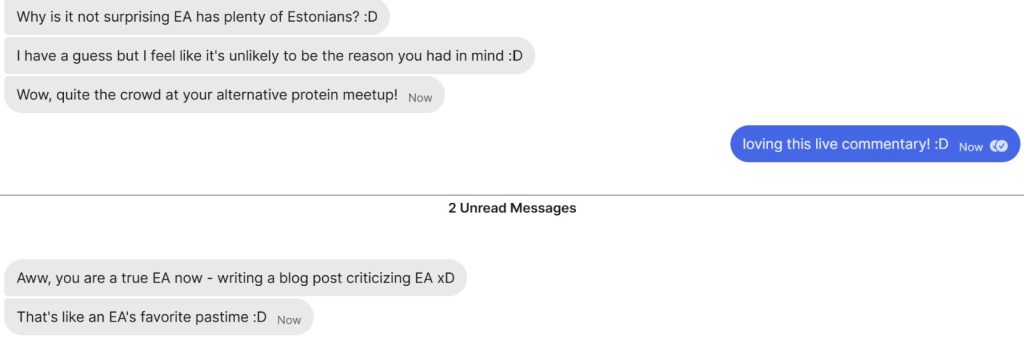
P.S. when I shared this post with a couple of my more EA friends, this was one of their reactions:
 Estere's page
Leave a comment